Eyes on Jupiter: the past and future of Earth’s existence
On different occasions, I have advocated investments in space exploration programs as an efficient means of developing disruptive technologies and, consequently, also a means of providing improvements to our daily lives in important areas: medicine, telecommunications, transport, computing, and environmental preservation.
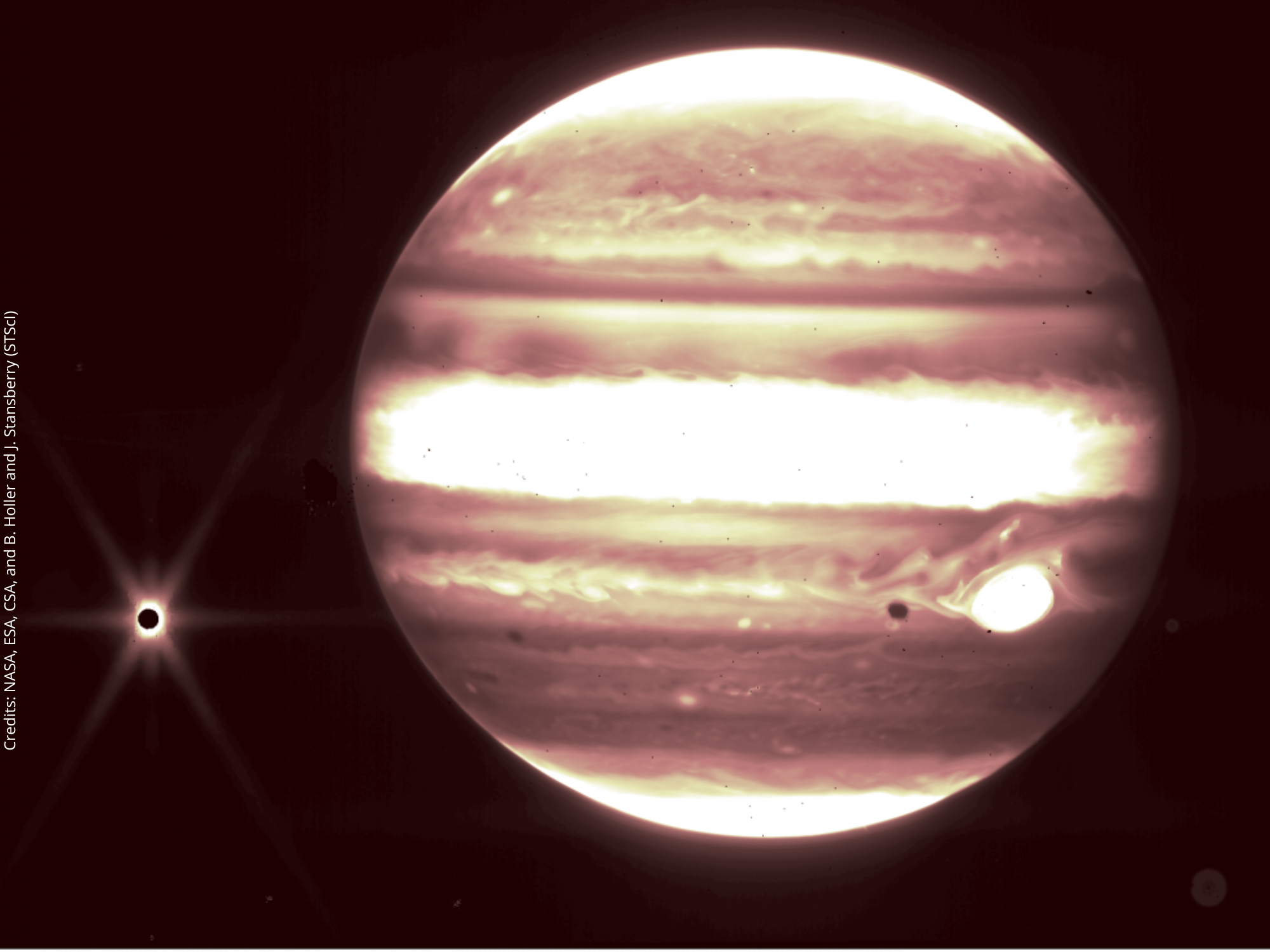
After the disclosure of the first images of the James Webb telescope , with details of a Nebula Carina star nursery, the United States Space Agency ( NASA ) brought to public images of the planet Jupiter. At this point, it is worth reflecting on the relevance of studies on the giant of our solar system: the past and future of the Earth relate to that planet.
Have you ever wondered why, among astronomers’ notes, there is only one episode of probable comet or asteroid shock of relevant size to Earth? In this case, this is the hypothesis presented for the great extinction event of dinosaurs 66 million years ago.
Thank Jupiter!
The planet, which bears the name of the King of the Roman Gods, has mass 318 times that of the Earth and 11 times the radius of our planet (the same proportion of a marble to a basketball). This giant holds a gravitational field that eventually blocks the passage of most comets and asteroids of the most relevant size. So much so that there is an asteroid belt between Jupiter and Mars.
During the search for images of Jupiter, the James Webb Telescope conducted a “speed limit” test to measure the ability to produce good images of a moving target. In this case, the lenses were pointed at an asteroid called 6481 Tenzing, located precisely in the asteroid belt between Mars and Jupiter. The data demonstrated that Webb tracks targets of the solar system and produces images and spectra in unprecedented detail.
Ultimately, monitoring the evolution of this great planet can be decisive for our future in the long run. Getting accurate data on Jupiter’s orbit and the implication of its trajectory and oscillations of the gravitational field can result in the qualification of the monitoring of comets and asteroids.
This issue is taken seriously by space agencies. NASA has been working on the development of the first space defense program and testing began with the Double Asteroid Redirection Test (DART ).
The goal is to alter the orbit of asteroids through kinetic impact by launching a spacecraft against the smallest member of the binary asteroid system. The probe that will perform this first test is already on its way and is expected to reach its destination on September 26.
Investments in programs for the development of disruptive technologies are relevant for most different areas. And this human capacity may be the most important factor for the perpetuation of our species.